
Industrial Repair Compound Production Process
Industrial repair compound production covers more than mixing materials. For industrial distributors and procurement teams qualifying a supplier, the key question is how material preparation, mixing, filling, packaging, process checks, final release, and records connect into one reviewable process. This production-process framework explains the stages used to organize an industrial repair material review and identifies evidence buyers may request. Production-process information should be considered alongside equipment, substrate, damage, service conditions, packaging, and technical documentation.
Process Coverage
What This Production Process Covers
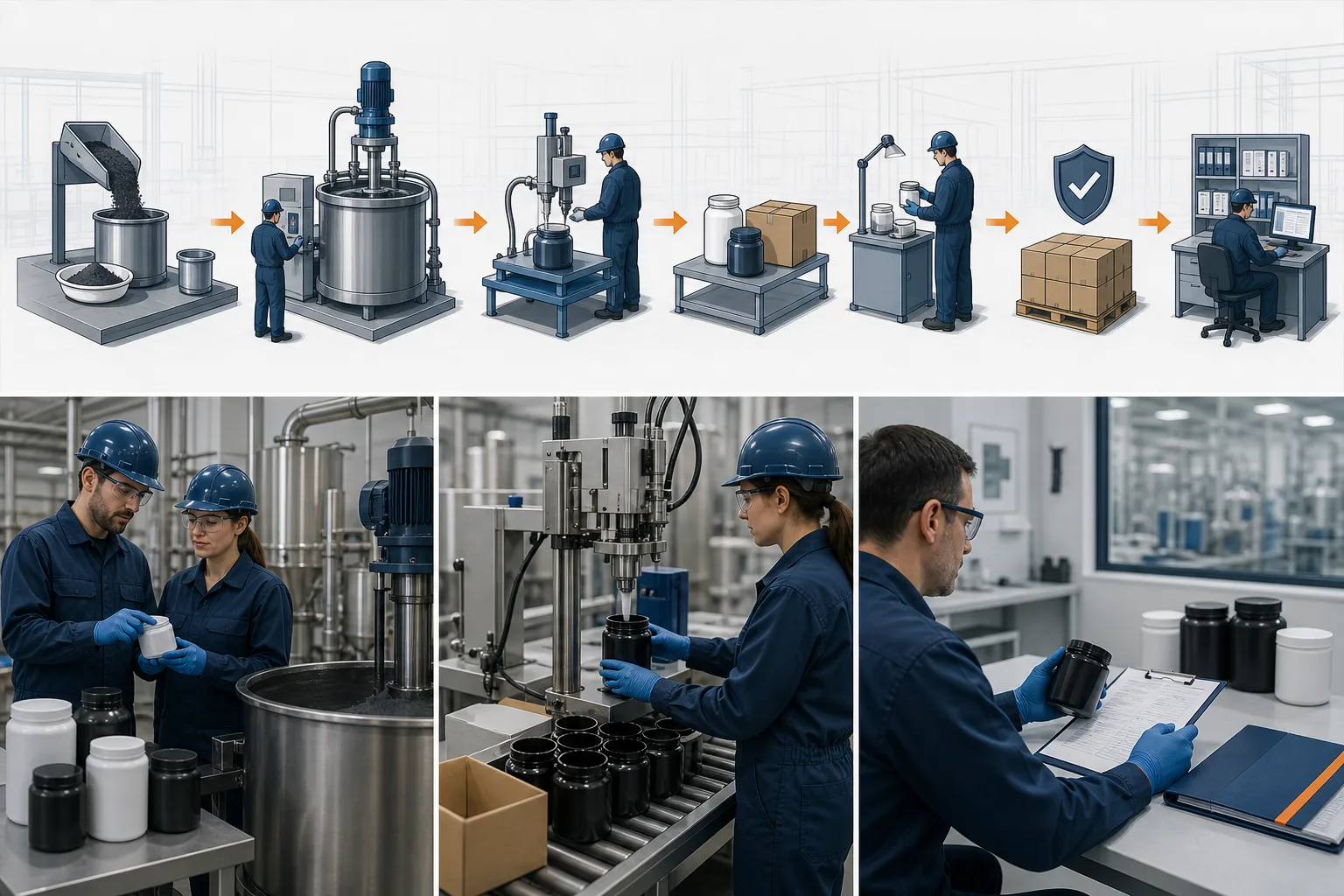
The ZDSChem production-process framework follows a controlled route from identified materials to released industrial repair products. The high-level sequence can support different product categories, while formulation instructions, control points, packaging requirements, and release criteria vary by product and order scope.
01
Batch preparation identifies applicable
materials, formulation version, batch information, and production instructions.
02
Mixing combines required components
according to the applicable product process.
03
Filling transfers mixed material into the
intended pack format and connects the product with its batch identity.
04
Packaging prepares labels, instructions
cartons, and supporting documentation where required.
05
Process checks review defined conditions
or observations during production and filling.
06
Final release compares finished-batch
information and applicable checks with product requirements.
07
Records and evidence support traceability
technical review, and purchasing discussions.
Seven Stages
Seven Stages From Batching to Final Release
Each stage connects production activity with product identity, applicable controls, packaging requirements, or reviewable records. Exact instructions and criteria vary by product.
Batching and Preparation
Identify raw materials, formulation version, batch information, and packaging route. Material status and lot references connect inputs with later records.
Mixing
Combine prepared components according to the applicable product instruction. Sequence, operating conditions, and batch identification should be defined for the product.
Filling
Transfer mixed material into the intended pack format. Review product identity, batch identification, fill requirements, and container or closure condition where applicable.
Packaging
Connect finished material with labels, instructions, outer packaging, and document requirements. Packaging and target-market requirements should be agreed before ordering.
In-Process Checks
Checks during production can identify issues before release. Criteria may relate to appearance, homogeneity, filling, packaging condition, or another documented requirement.
Finished-Product Release
Bring production information and finished-batch checks together. Review available records, nonconforming-material handling, and shipment documents where applicable.
Records and Evidence
Maintain identifiers and documentation connecting materials, production activity, packaging, and released batches for traceability and technical review.
Buyer Review
Control Points Buyers Should Examine
This framework helps distributors, procurement teams, and technical evaluators structure a production-process discussion. It identifies evidence categories to request without implying that every item is available for every product or order.
Batch Preparation
Review material identity, formulation version, and lot references. Request material status records, batch instructions, or weighing and dispensing records where applicable.
Mixing Controls
Review defined sequence, applicable operating conditions, and batch identification. Request production logs or in-process records linked to the relevant batch.
Filling and Packaging
Review product route, pack requirements, identification, and packaging condition. Request filling or packing records, labels, and applicable packaging checks.
Final Release
Review completion of applicable checks against product requirements. Request release, inspection, or other applicable quality documents.
Traceability
Review connections between inputs, batch identity, packaging, and supplied documents. Request batch or lot references and supporting document records.
Material Selection
How Process Review Supports Material Selection
Production-process information helps assess supply discipline, but it does not make different repair materials interchangeable. Selection should begin with the failed equipment and repair objective, then consider substrate, damage type, service conditions, application method, and documentation requirements.
01
ZDS-MetalRebuild
Metal rebuilding, cold repair, dimensional restoration, leak sealing, and structural bonding.
02
ZDS-CompositeWrap
Composite pipe reinforcement, FRP repair, and structural laminating.
03
ZDS-CeramicArmor
Ceramic-filled protection for wear, erosion, cavitation, and heavy-duty equipment surfaces.
04
ZDS-AquaShield
Underwater-curing, wet-surface, marine, and emergency repair applications.
05
ZDS-FluidGlide
High-temperature repair, chemical-resistant lining, tank lining, flue protection, sealing, and fluid-equipment coating.
06
ZDS-PolyAspartic
UV-resistant, weather-stable, and outdoor protective coating applications.
07
ZDS-RubberElast
Repair routes for conveyor belts, rubber linings, rollers, cables, tires, and elastomer components.
Qualification Documents
Records and Documents for Supplier Qualification
Technical and procurement reviews should begin with the documents needed to identify, evaluate, handle, and purchase the material. The applicable document set depends on the product, target market, order scope, and buyer requirements.
Product identity, revision, and intended
application information
Batch or lot identification connected to
the supplied material
Packaging, labeling, and handling
information
Applicable production, inspection, or
release records
Technical and safety documents required by
the buyer or market
Evidence needed for receiving inspection
storage, and repeat purchasing
Quality and Support
Quality Management and Technical Support
ZDS has operated as a professional chemical manufacturer since 1998. A dedicated R&D team of 30 professionals supports new product development, formulation review, product improvement, application adaptation, and customer-specific chemical requirement review. Technical experts with more than 30 years of experience contribute to formulation and application discussions when a project requires additional technical context.
Prepare for Review
Information to Prepare Before a Process Review
A focused inquiry helps connect the production process with the commercial and technical decision. Prepare the following information where available.
01
The product series or repair category
being considered
02
The equipment, substrate, damage type, and
affected area
03
Temperature, fluid exposure, immersion
weathering, load, abrasion, or other service conditions
04
Application method, shutdown limitations
access conditions, and expected repair sequence
05
Packaging, labeling, documentation
target-market, and language requirements
06
Expected purchasing volume, initial
stocking needs, and repeat-supply plans
Scope and Limits
Limits of a Production-Process Overview
This overview explains process logic for supplier evaluation. It does not establish exact production equipment, facility scale, batch capacity, annual output, yield, lead time, fill quantity, mixing parameters, cure data, performance values, or release limits. Those details require confirmation against current ZDS documentation and the scope of the specific qualification request.
01
Process evidence cannot replace an
application assessment.
02
Final material selection requires relevant
product documentation and information about the equipment, substrate, damage, and service environment.
03
Customer-specific formulation, packaging
labeling, and product-line requirements can be reviewed conditionally.
04
Technical and commercial feasibility must
be confirmed after the product need, specification, expected volume, and target market are supplied.
05
A process discussion does not guarantee a
custom formulation, packaging change, private-label route, or product-development outcome.
06
For buyers moving toward purchasing, a
sample-to-bulk workflow can provide a practical next step, with acceptance criteria and commercial terms confirmed before bulk supply.
Next Step
Build a Documented Supplier Review
Share the product category, target market, expected volume, documentation needs, and any quality or packaging questions. ZDSChem can identify the appropriate review route and explain which evidence is available for the requested scope.
FAQ
Frequently Asked Questions
The process framework covers batching and material preparation, mixing, filling, packaging, in-process checks, finished-product release, and records or evidence. The exact instructions and control criteria vary by product.
Ask which batch or lot identifiers, production records, filling and packaging records, inspection records, release documents, technical data sheets, and safety data sheets are available for the specific product and order scope.
No. Process review supports supplier qualification, but material suitability requires information about the equipment, substrate, damage, service conditions, application method, and current product documentation. Sample evaluation may provide an additional step when the criteria are defined.
ISO 9001 and IATF 16949 are quality-management system certifications. They support the company management and process-control framework but do not certify individual repair compounds or prove suitability for a specific repair. Current scope and validity should be confirmed during qualification.
Customer-specific formulation, packaging, labeling, and product-line requirements can be reviewed conditionally. The technical team needs the application, specification, expected volume, target market, and commercial requirements before technical and commercial feasibility can be confirmed.